
|
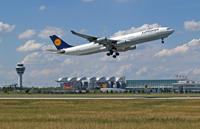
Boosted by visitors to the city’s famous Oktoberfest as well as increasing holiday travel, Munich Airport enjoyed its best summer ever in 2010, handling more than 10 million passengers in three months. On October 1, almost 130?000 passengers walked through its two terminal buildings, setting another record for the airport. Cargo traffic is booming too, increasing 29 per cent the same period in 2009, a sign of the recovering economy. Though Frankfurt, home of Lufthansa, the national flag-carrier, remains Germany’s busiest airport, Munich’s fast-growing operations may soon eclipse it. Opened in 1992 on a large rural site near the town of Freising, Munich Airport has two 4000-metre runways, each 60 metres wide and capable of handling the very largest airliners. Spaced wide apart, they can function as separate airports, achieving a large advantage in traffic capacity over airports which are confined to a more compact layout. Buoyed by its traffic forecasts, the airport’s operating company is already planning a third runway to be built alongside the present site. Airport operationsOne of the factors contributing to Munich Airport’s efficient operation is a TETRA digital mobile radio system, supplied by Motorola a few years ago. Responsible for this network is the airport’s IT department, whose 180 staff develop the main IT applications and operate and support the entire IT world at the airport. This also includes two data centres, the internal telephone system, closed-circuit television (CCTV) and a large data network – services with which the TETRA network and its wireless applications are becoming increasingly closely integrated. With its IP-based architecture, the Motorola Dimetra IP radio technology fits naturally into this digital environment. At present, some 1900 TETRA radios are in use across the airport, alongside a fixed communications system with nearly 13?000 telephones connected and a local area network with more than 12?000 active LAN ports, including PCs and workstations. Through these systems, the IT department serves more than 500 customers at the airport. Among them are airlines, ground handlers and public authorities such as the police and border guards. At the same time, the network supports airport services such as the flight information display screens in the passenger terminals. “We are also operating some other systems that are not typical of IT”, says Michael Zaddach, head of the department. “There’s a multilateration system to locate the aircraft here on the ground with a transponder signal from the aircraft and with fixed antennas on the ground – so we can do an exact location of every aircraft and identification of the aircraft because the transponders send a unique identifier. It’s something new. There are some airports in Europe that have already introduced this technique, but not all. “We have also location services on the ground to locate all the vehicles. There are more than 800 vehicles on the system. It gives us a help to have an efficient process to dispatch all these vehicles on the ground. And we have a huge wireless LAN infrastructure with more than 350 access points in the terminals and also in the outside areas.” At the core of the department’s operations are 50–60 software applications, ranging from enterprise resource planning for the administrative offices to numerous specialized applications connected with airport process management. Many of these have been developed within the department itself. One very large project it managed and executed recently was a migration of the airport’s CCTV systems from analogue to digital. Some 1800 cameras were involved. Switching to TETRAMigrating the airport’s private mobile radio installation to digital was an earlier project which began five years ago. The previous network, an analogue trunked system by AEG, had been in operation since the opening of the airport, but support was no longer obtainable from the manufacturer and replacement parts were becoming impossible to find. “We had more and more problems with the old system”, says Michael Zaddach. “That was very critical for us, because the operation depends on smooth operation of the radio system. “Another point was that the old terminal devices were very big and heavy, and the users were always comparing the old devices with new mobile telephone devices. They couldn’t understand why they needed such a big device!” But compact, pocket-sized terminals were not the only advantages of the TETRA system. It also brought advanced functions and communications features such as dynamic talkgroups, secure speech over the air and better voice quality, especially for users out and about on the apron. “If you are talking via TETRA near a running aircraft, the communication now is much better than before”, Zaddach explains. “The noise is suppressed.”
|
 A large